

Two years ago, I traveled to Las Vegas for Money20/20 which was hosted at the massive, Italian-themed Venetian hotel. At that point, I was Sitecore’s global industry advisor for the financial services vertical, and I had just finished building a campaign visualizing cross-channel digital journeys for major retail banks. I also had the DXMM (Digital Experience Maturity Model) assessment on an iPad, at the ready for marketing and IT attendees that visited our booth.

The night before the conference began, I walked down to the floor where our sponsor booth was getting set up, and I was surprised to find our oversized backdrop banner missing two essential words, “The ____________ trusted by financial services leaders.” Somehow the words “experience platform” were omitted by the print shop. Sitecore’s fantastic field marketing team had it reprinted and resolved by the next morning when attendees arrived.
Looking back, the typo was fitting. Money20/20 is a sprawling, decentralized conference without a main stage. It was hard to find CMOs or digital experience leaders to meet with, because the floor seemed to be packed with thousands of product leads at fintech startups solving identity verification, fraud prevention, or payment processing. Hundreds of booths pitched variations on the a theme around fraud prevention and deep fake detection in banking: proving you are who you say you are. Just around the corner from the booth where we were posted was Socure, an identity verification company, and I even wandered over to try a selfie check. Back then, I remember joking with other attendees that it was easy to spot an AI image: “it’s not hard to count fingers.” Now, I’m not so sure. Watching the Braves in the playoffs in October, I couldn’t tell whether the doctor in a J&J drug ad was a real actor, as I wrote in No. 009.

The same month I was in Vegas, Sam Altman’s eye-scanning project World was unveiled and new Orbs were deployed to dedicated retail spaces in major cities. World’s intent was to capture a database of biometrics so you can use the tech to prove you’re human.
It’s not just me that struggles to detect generated faces, though. In 2022, people looking for AI faces were right 48.2% of the time, less accurate as a coin toss, and the respondents rated fake faces as more trustworthy than the real ones. Researchers at the Australian National University found AI faces are judged human more often than real faces, and the people worst at spotting AI were the least aware of it.
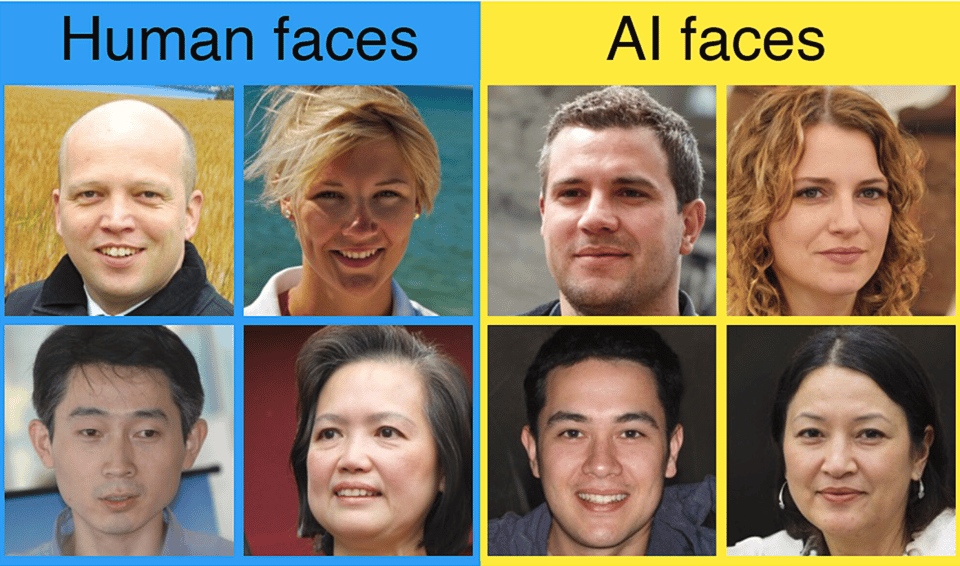
New research exposed a tell. AI generators build a face by averaging millions of photos until all the rough edges get sanded off, so the resulting image is just a little too symmetrical, a little too attractive, and almost instantly forgettable. AI often generates the kind of face you’d swear you’ve seen before precisely because, statistically, you sort of have. When people learned to look for the average, their accuracy roughly doubled.
In “Faces,” an essay in Karl Ove Knausgaard’s Autumn, he points out that most things in life take training to see well, but human faces don’t. Every face is essentially built from the same few parts, and yet we perceive “every single face as being unique, even the most ordinary of the ordinary.”
AI-generated faces slip by us by sanding off the small differences we’ve all evolved to read.
In just a couple of years, the scope has widened from images to actions. Now it’s sometimes hard to tell whether a customer is a person or an agent acting on behalf of one. The same bank and insurance marketing leaders I met in Vegas are now building distinct experiences for the split. Others are blocking agents at the door.

When I was at Sitecore, we acquired Scrunch, an AI-native startup that identifies AI agents browsing on someone’s behalf and splits content in two: a machine-ready payload for the agent and a richer, more engaging experience for the human. The innovative platform goes beyond AEO and GEO, the race to get cited in AI answers, and works out who’s on the other side of the screen before delivering optimal content.
Your customers are getting harder to tell apart. For thirty years, the web has competed for human attention. Now experience strategists are designing digital content for both human and agentic audiences.
This was originally posted as the Feature in Average Faces · The Catalog · №011, an issue of my weekly newsletter The Catalog. You can Subscribe for weekly insights.
Leave a Reply