

I’ve worked on experience strategy projects with major brands to increase click-to-call, and with other brands to decrease it.
Law firms, accountants, and car dealerships carefully track web-attributed calls as a conversion because they want you on the phone since a call is a lead. Direct-to-consumer brands and product support lines, on the other hand, aim to decrease calls to the call center. They’d rather serve you the right FAQ than pay someone to answer.
A few months ago, I was the customer stuck on hold with that second kind of brand. Less than a year ago, I bought a pair of smart glasses from a retail store in The Rocks, in Sydney. I mostly used them to listen to podcasts, and then they broke.
My sunglasses were still under warranty, so I started with the retailer’s US support chat. I’m still not sure if I was talking to a real person. Whoever it was looked at my receipt and told me the US side couldn’t honor a warranty on something bought in an Australian store. The 1-800 number sent me through a phone tree and back to an online form. The form prompted an email asking me to open a case. Eventually, the retailer passed me to the manufacturer, where I hit the same wall: a receipt from Australia and a home address in the United States.
It took a week and a half just to resolve and get return shipping labels, and three weeks from start to finish for a new pair. I thought about giving up more than once. What kept me going was the price of the glasses and the principle of the thing: the glasses were defective, and I’d had them less than a year.
That customer support loop isn’t an accident. Customer service often seems to be purpose-built to see how much effort people will spend. Phone trees, hold music, chatbots, and mail-in forms are sized for people who get tired, forget, and give up. Try reaching an actual person at Amazon about a lost order, or at Uber when it isn’t a safety issue. Seinfeld’s “The Cadillac” got this right in 1996, when Kramer flips the roles and makes the cable company wait on him.
For years, companies used machine learning to cut that load even further. Now the customer has a personal AI agent too. A personal agent is an AI assistant that can act on your behalf: fill out forms, send emails, and keep following up until the job is done. Four of the big ones:
Muse (Meta) – a free app that works in one ongoing chat. It shops, books appointments, and makes reservations, and it asks before it buys anything.
Dots (OpenAI) – always-on agents, each with its own name, that work across ChatGPT, Slack, and Teams. The first one comes with ChatGPT Pro.
Grok Bot (xAI) – gives each agent its own cloud computer, so it can sign into the same apps and inboxes you do.
OpenClaw (free and open source) – first released and the most technical to set up.
All four personal agents above can run around the clock, and your agent doesn’t care if it’s the middle of the night when it needs to call Australia.
Ethan Mollick put it plainly.
“We will soon see what will be, in effect, a perfectly legal distributed denial of service attack on customer service departments authorized by millions of consumers when it becomes widely known that Muse/Dot/Claw can make unlimited requests for old refunds, negotiate deals, etc. using the channels reserved for humans.”
Ethan Mollick, Wharton professor
This kind of thing is already happening. One early user pointed Muse at an idle Google Cloud charge. Google said no, and the follow-up Muse drafted got $114.14 waived 39 minutes later. That’s a year of forgotten charges, recovered in less time than I spent on hold.
If you’ve sent Muse, dots, Grok Bot, or OpenClaw after a refund or a cancellation, reply and tell me what worked or where it got stuck.
The math gets interesting downstream for refunds, rebates, and warranty policies because they’re priced on the people who never follow through. In one University of Florida study, a third of people who bought a rebate offer never mailed it in, and most of them blamed procrastination or forgetting. Your agents won’t forget.
I bet policies built on forgetting will get repriced, starting with the hardest exits, like cancelling gym memberships or cable contracts.
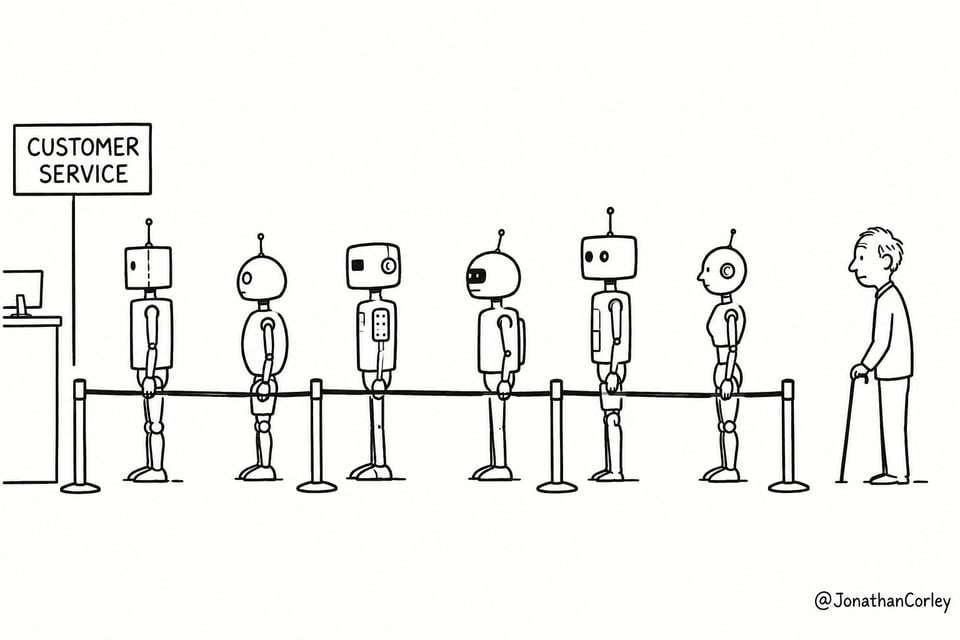
I’m worried about who ends up at the back of the line.
Picture a grandparent trying to buy their granddaughter a ticket to a sold-out show, waiting behind thousands of agents that never get tired. The most genuine customers could end up waiting the longest.
For decades, I sympathized with the customer stuck on hold. Now part of me sympathizes with the brands staring down a rising tide of personal agents. I expect the ones that build a dedicated door for agents will spend less on service than the ones counting on customers to give up.
This was originally posted as the Feature in Queue the Agents · The Catalog · №010, an issue of my weekly newsletter The Catalog. You can Subscribe for weekly insights.
Leave a Reply