
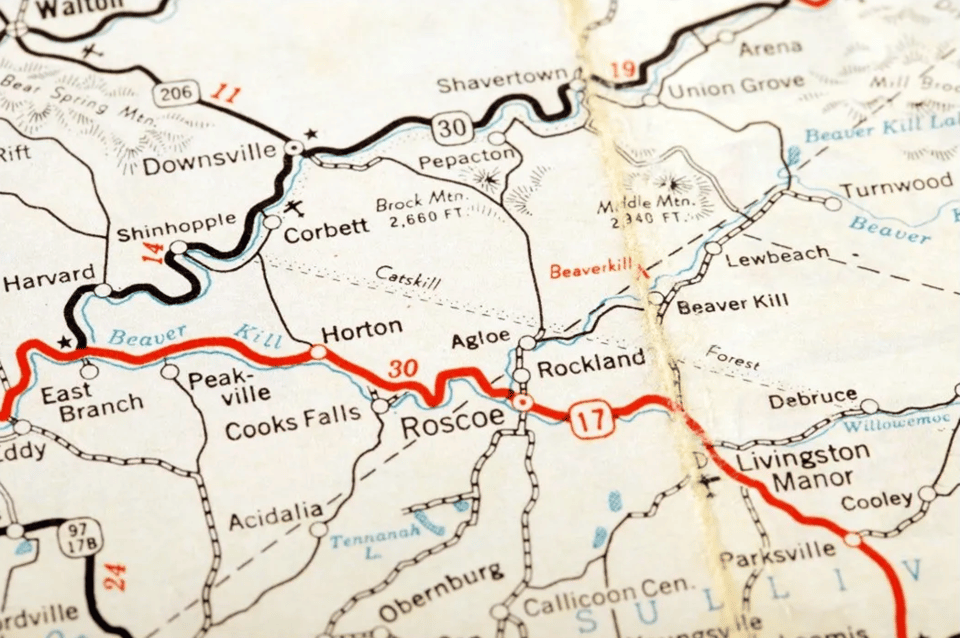
In the 1930s, two mapmakers at the General Drafting Company invented a town in the Catskills. Otto G. Lindberg and Ernest Alpers scrambled their initials into a name, Agloe, and placed it where a country road meets NY 206 near Roscoe.
This fake town was a trap.
If Agloe ever showed up on a competitor’s map, they’d know exactly who copied them.
Then things got strange. Someone actually opened an Agloe General Store at the intersection because the map said a town was there. When Agloe turned up on a Rand McNally map, Rand McNally pointed to the store as evidence for including the town on its map. The fake town had become just real enough to plausibly deny plagiarism.
This “paper town” tactic gets reused today. In 2011, Google planted about 100 nonsense searches like “hiybbprqag” with hand-picked results, then watched them show up on Bing. More recently the crowdsourced lyrics database and song annotation platform Genius alternated straight and curly apostrophes in its lyrics to spell out the words “red handed” in Morse code. Genius found the pattern in more than 100 of Google’s lyric results.
Genius still lost in court, because it didn’t own the lyrics it had transcribed.
I found my own paper town during my final weeks at Sitecore. A colleague headed to Australia asked me to help them prepare for a personalization workshop, because the customer had already been working on implementing “their personalization roadmap.” When we opened the roadmap together, I immediately recognized my own work. The first activity on the roadmap summary slide read “Onsite Workshop in UK.”
This was certainly a screenshot of a client roadmap I’d delivered almost a year earlier to a different customer, in a different industry, in Europe. I recognized my swimlanes and the 30 or so activities and tactics we’d numbered and ordered together onsite. I’d written and carefully phrased each item on the slide together with that account team about a year ago.
I don’t normally mind when people build on my work. I like creating systems and frameworks that scale. In the band, hearing up-and-coming bands influenced by MO’s albums was rewarding. At Sitecore, I’d sometimes spot my sketches in ppt decks presented in places I’ve never been like India or Saudi Arabia, and that made me proud. Sharing Customer A’s plan with Customer B is a different story, though.
That sort of thing will get harder to identify. AI won’t hand anyone a screenshot with “UK” on it. It hands back a generic and polished copy of a copy that’s close enough to good.
I’ve even tested this myself, like in the video below from 2023.
Over the years I’ve reverse engineered many of my own strategic planning methodologies and frameworks by using AI to make a guess with outside-in information, and the results landed somewhere between inspiring and disillusioning. The 2023 video above walks through two simple use cases I setup with an early version of GPT-4. Back then this sort of work was a novelty for strategic consultants. Today’s new frontier AI models rapidly finish entire account research reports that used to take me entire workdays to complete.
This sort of outside-in, AI-driven strategy can look good to casual observers, but today it doesn’t really get work done. The people responsible for building or creating didn’t come up with the ideas, vote on them, or agree on dependencies and what needs to get done. An agentic execution layer will soon change that, and it could lead to a sea of sameness across categories.
The Australian team I mentioned had a screenshot of a plan without any of the rationale, context, or ownership in the decisions behind it. That’s exactly why they weren’t sure where to begin.
These last couple of weeks, I’ve been looking closely at the intersection of entertainment and technology, and how it shapes culture. I keep coming back to businesses and projects positioned to ride the coming wave of agentic AI: leisure, live entertainment, and the software at the center of how work gets assigned and distributed between people (and increasingly machines). Each one sits close enough to human passion, or to how work actually gets done, that it gets more valuable every time the models get better.
Top image: Paper town of Agloe, NY via Colchester Historical Society
This was originally posted as the Feature in Paper Towns · The Catalog · №013, an issue of my weekly newsletter The Catalog. You can Subscribe for weekly insights.
Leave a Reply