

I am back in the UK this week to facilitate workshops for two large enterprise brands, based in Folkstone and Cardiff, helping their digital marketing teams begin building a roadmap of experience strategy use cases and initiatives, and exploring how their content operations might soon evolve and adapt to the latest capabilities of AI.
On the flight over, I started reading a book by Buckminster Fuller called Operating Manual for Spaceship Earth (1969). Fuller was a philosopher and the architect behind modern geodesic domes, but what stands out to me were his insights about how we see ourselves and our place in systems.
After landing in London I stopped by the Columbia Hotel bar and lounge and read a few chapters of Spaceship Earth there. The Columbia is where I stayed with my band before our very first international show in London on tour nearly 20 years ago. In the early 2000s it was a rite of passage for a lot of musicians touring through London. There’s something rewarding about revisiting old ideas in new contexts, and some of Fuller’s decades-old frameworks around systems theory make a lot of sense when you apply them to AI’s impact today.
Fuller tells a story about birds:
There was a species of bird that eats fish, and it found a rich food source concentrated in bayside marshes. Instead of ranging wide, they stayed near the marsh where fish were plentiful. Their environment rewarded them for it and generation after generation, birds with longer beaks could reach deeper into the marsh holes and get more food. As the marsh became deeper the short-billed birds died off. Long-beakers thrived, bred, and evolved to pass on their genes. The marsh kept receding. Their beaks kept growing.
Then a fire broke out. None of the long-beaked birds could fly. Their beaks had grown so heavy over generations of optimization that flight was no longer possible. They couldn’t escape and the entire species perished. Fuller’s conclusion is blunt: this is how extinction occurs, through over-specialization.
I think that in some ways, marketing and technology teams have been over-engineered in ways that create organizational risk. Experts have developed deep expertise in a platform, or a specific channel. Subject matter experts have mastered disciplines like content strategy, front-end development, data architecture, or campaign operations. The enterprise marketing environment has rewarded this sort of specialization. Job descriptions were written around it and entire team structures were built to support and enforce it. And for a long time, it worked well. It worked because the tools we used for enterprise marketing everyday required it.
For at least a decade, specialization made sense in martech because complexity created natural role boundaries. A Content Management System had a specific operator. You brand’s Customer Data Platform had a specific owner, and a team of specialists to cleanse and segment the data into actionable audiences. Personalization engines required developer involvement to build templates and configure custom rulesets. Swim lanes formed at the platform level and crossing them was genuinely hard and required understanding entire systems’ architecture.
AI is now lowering the barrier of entry required to use marketing technologies. In many cases you can simply describe what you need and the agentic systems will do the work inside the various software platforms to make it happen. All of the major AI systems are moving so fast. I was personally an early adopter of ChatGPT, but just swapped my OpenAI license for a Claude subscription last month after experimenting with Claude Code. Every few months it feels like Google, or these major AI companies are leapfrogging each other as the latest models are adding more capability than ever at completing complex tasks over a long time.
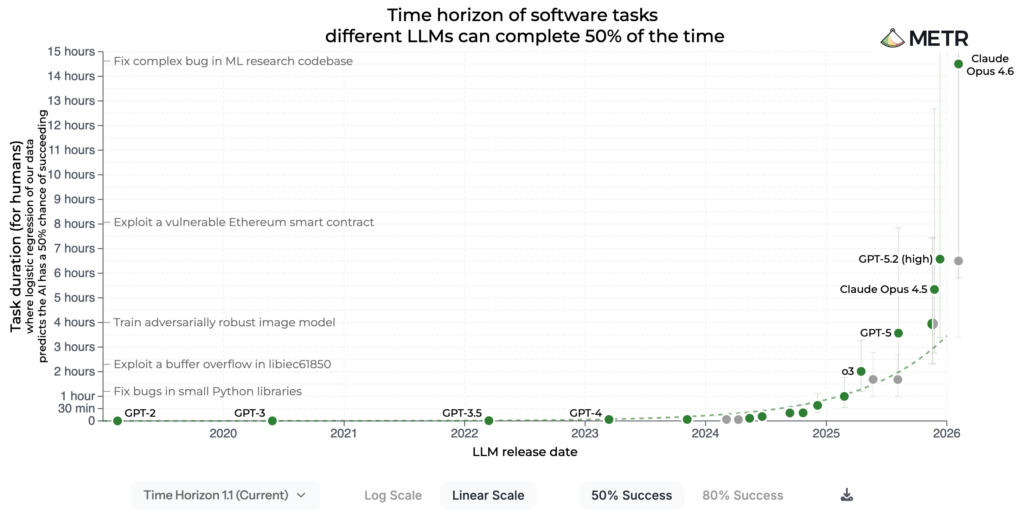
In the chart above METR is tracking the duration of real-world tasks (measured by how long they take a human expert) that the latest leading LLM models and agents can complete successfully without human help. Only a year ago, this was about ten minutes. In November ChatCPT and Anthropic’s Claude were up to getting things done that take an average human expert five hours. In just a few months Claude Opus 4.6 has already jumped to 12+ hours. That metric is doubling every six months or so.
In an essay in February 2026 Matt Schumer wrote, “if you extend the [METR] trend (and it’s held for years with no sign of flattening) we’re looking at AI that can work independently for days within the next year. Weeks within two. Month-long projects within three.”
The boundaries between specialized knowledge work are blurring at a rapid rate. Our existing tools become both more powerful and more permeable. Colleagues are starting to cross boundaries that used to be enforced by technical complexity. A marketer with a well-structured prompt can now do (in minutes) what previously required a developer ticket and prioritization into the next two-week sprint. A developer creating an agentic workflow is determining content sequencing decisions that used to belong to a strategist.
This presents a challenges for enterprise marketing leaders right now. The shape of a marketing team and general organizational design was built to support the complexity of experience delivery. Team structures, RACI charts, agency relationships, platform ownership, and budget allocation all assumed that disciplines would stay in their lanes because the systems required it. That assumption is may not be as valid as it used to be.
As marketers and technologists we have each mastered our corner. We understand our platform or dashboard, and we should be careful not to mistake it for a complete picture.
I don’t think brands doing the most innovative work in the future will be the ones with the deepest specialist expertise. They’ll the ones restructuring teams around outcomes rather than disciplines. These innovative new teams can hold multiple capabilities at once comprised of people who can think anlongside AI systems and work across content, data, and delivery without waiting for a handoff. The job description that you were hired for and the job you’re actually doing these days are quietly become two different things.
Digital experience leaders who recognize this today are getting ahead of it. The ones who don’t might find themselves managing an org chart that no longer maps to how work actually gets done.
The marsh is still here for now. Over-specialization is a survival strategy right up until the point where it isn’t.
Leave a Reply