

CAREER UPDATE
July 2026 was my last month working at Sitecore. After nine years of working for the world’s leading digital experience platform, I was laid off, along with my entire global team, in a wide range of cuts across multiple departments. Many of those impacted were strong performers actively innovating and adding value to the organization, so the decision was unexpected.
I am grateful for my time at Sitecore, and for the people that helped make my last decade so memorable. The experience was invaluable. I made lifelong friends, learned constantly from the people around me, and got to build and deliver strategic and creative work I’m genuinely proud of.
Thank you, Sitecore! I can’t wait to see what you do next.
I’m looking for my next role, and I’d welcome your help finding it. If you’re hiring, or know of an opening in marketing leadership, martech consulting, experience strategy, solution consulting or agentic AI advisory, let’s talk.
While I’m focused on the next step of my career, I’ll be posting less here but you can subscribe to my newsletter.
3 of my recent articles and guide
1. The AI-influenced traveler
Read the article: https://www.sitecore.com/resources/insights/artificial-intelligence/ai-influenced-traveler
A search results page has a page two, page three, and endless scroll. AI answers do not. The AI-influenced traveler sees three to five options and picks one. If you are not in that list, there is no “below the fold.”
This new paradigm creates a scarcity that’s colliding with collapsing web traffic dynamics. In a 2025 video interview, Cloudflare CEO Matthew Prince traced the trend through a single ratio of pages search and AI engines scrape versus visitors they send back:
- Google, a decade ago: 2:1, two pages scraped for every visitor sent back
- Google today: 18:1, the trade has gotten nine times worse
- AI assistants today: OpenAI at an estimated 1,500:1, Anthropic at 6,000:1
Follow these ratios to their natural conclusion and a site’s audience inverts to a mode where machines reading your content outnumber humans by such a wide margin that it influences the strategic objectives of your website.
That sounds like a loss, and for brands built entirely on buying top-of-funnel traffic, it might be. I’m already seeing strategic experience leaders in travel and hospitality who have turned the corner. They have stopped chasing clicks they can no longer depend on and prioritized ensuring their brand is the one the AI understands clearly enough to recommend. They are building toward a future where their brand content positions them as the authoritative answer, then converts the smaller, far more decided audience that answer sends them.
Here is what that looks like at ground level.
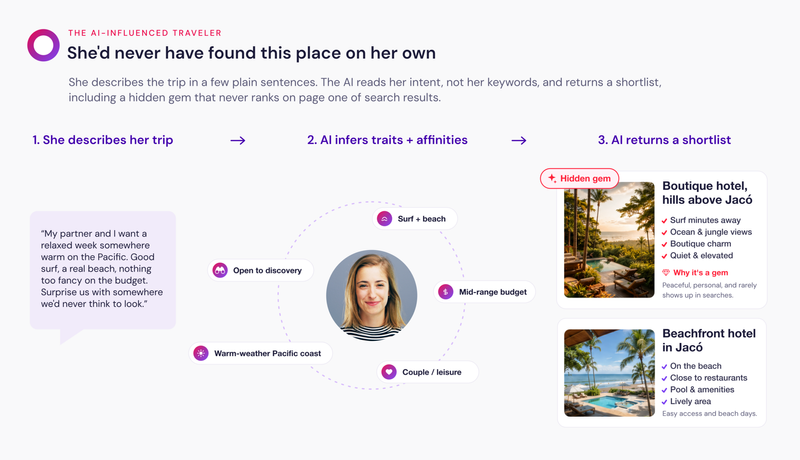
She isn’t defined by a device type or app like the mobile or connected traveler. She’s influenced by AI upstream during the decision-making process, within AI chat or agentic interactions, often before your brand has a say. The AI-influenced traveler has moved well past early adoption. Fifty-six percent of American travelers are now using AI to plan, book, or navigate their trips. That is a remarkably fast adoption curve, and unlike earlier platform shifts, most travel brands have yet to restructure their digital experiences around it.
The AI-influenced traveler is no longer an edge case. She’s the default, and she is making decisions inside AI conversations, before your brand has a say.
This booking experience matches what I’m hearing from operators. Last year, Sitecore and Ogilvy One published a whitepaper I co-authored with Christopher Brewer, Who Really Has a Grasp on a Traveler’s Journey, and we took its findings on a roundtable tour with marketing leaders across Sydney, Hong Kong, and Singapore. In rooms with brands like Mandarin Oriental, Cathay Pacific, Carnival Cruise Line, Crown Resorts, and Gardens by the Bay, the same theme surfaced in every city: generative AI and chat interfaces are reshaping how travelers research and book, faster than most teams have restructured to keep up.
2. Most travel brands are already losing visibility to AI-driven search
Download the report:
https://www.sitecore.com/solutions/industries/travel-hospitality/ai-driven-visibility-conversion-report
The traveler’s path from inspiration to booking has compressed. AI assistants now compare options, surface recommendations, and shape consideration sets before a traveler ever reaches a brand site. For travel brands, the moment of influence has shifted upstream, and most organizations aren’t yet positioned to compete for it.
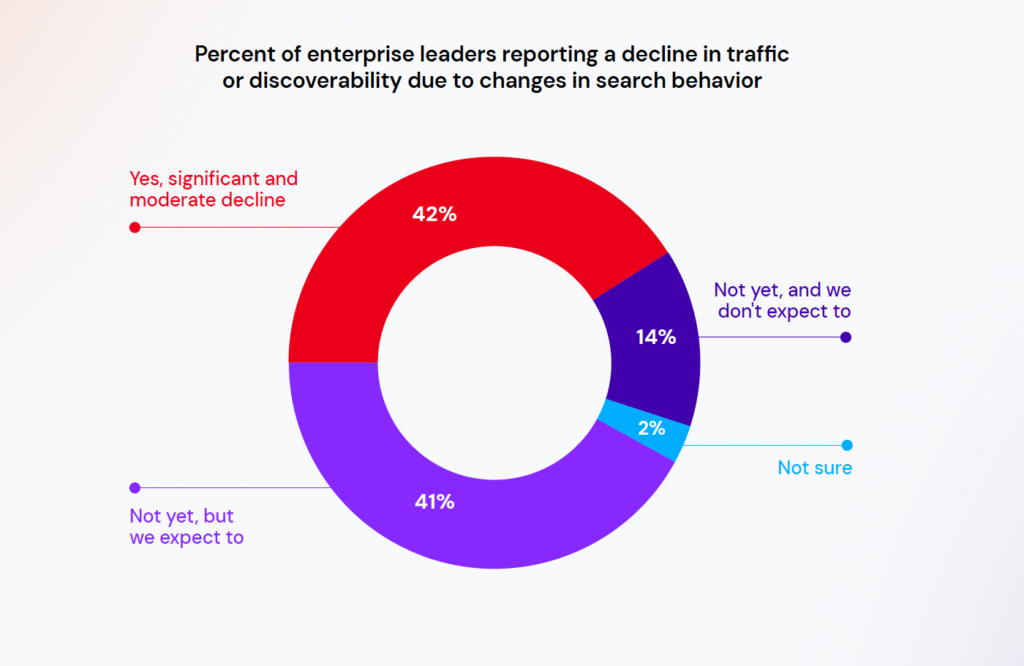
Sitecore’s new research, “Winning Visibility and Conversion in an AI-Driven Travel Economy,” draws on survey data from 1,009 enterprise leaders across four global regions. Forty-two percent are already reporting declines in traffic or discoverability. Sixty-four percent say GenAI is outpacing their content operations. Fifty-five percent expect to lose competitive advantage within two years without investment in digital experience. The report identifies three priorities: structuring content for AI interpretation, modernizing discovery and booking for AI-led journeys, and designing omnichannel experiences that convert high-intent demand.
3. Experience strategies in Travel and Hospitality
Read the full Article here: https://www.sitecore.com/resources/insights/artificial-intelligence/ai-experience-strategy-travel-hospitality
A year ago, 14% of American travelers were using AI to plan or book. Today it’s 56%. The adoption curve for generative AI in travel has no precedent in modern hospitality, and it is moving faster than the shift to mobile did. The starting point of most journeys has moved: travelers now have a conversation with an AI that compares options and surfaces brands, often before a website ever loads.
In my new Article on Sitecore.com, the first in a travel and hospitality series, I work through what these changes mean for experience strategy: how the discovery layer is being rewritten as SEO turns into GEO, why personalization that amplifies human connection builds a kind of compound loyalty competitors struggle to copy, and how agentic tools let lean marketing teams serve every segment instead of only the most valuable ones.
For more insights like these subscribe to my newsletter.
Comments
One response to “Before the Journey Begins”
Great content! Keep up the good work!