

Last month, Moderna’s stock jumped after its personalized mRNA melanoma vaccine with Merck won a Phase 3 trial.
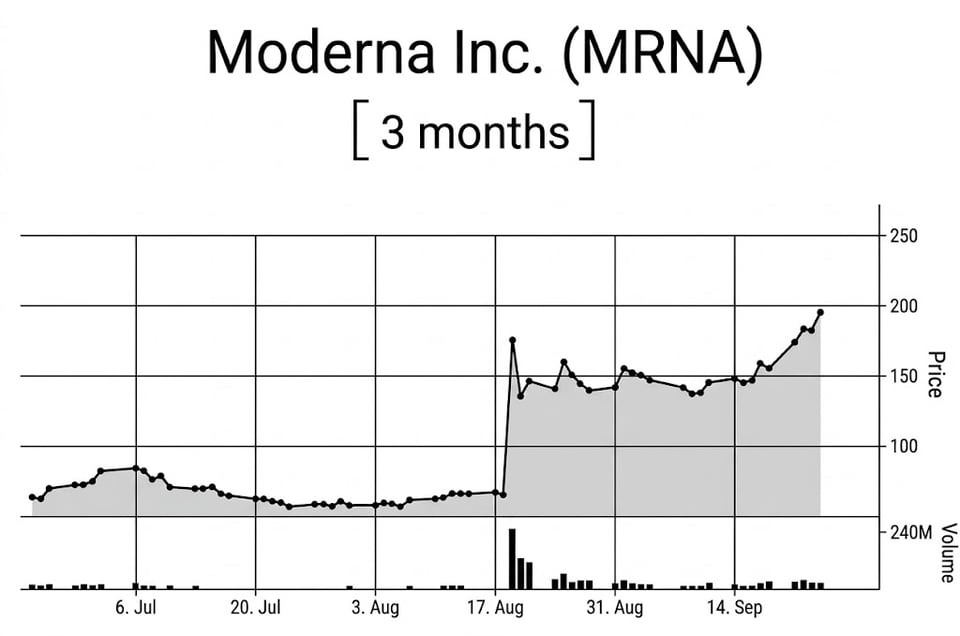
The market paid attention when Moderna announced late-stage trial results for its melanoma cancer vaccine.
Their first patient got a dose of the vaccine in 2017, and it took about a decade to prove out. Here’s how it works: Moderna sequences a patient’s tumor and uses algorithms to rank its unique neoantigens (markers that separate the cancer from healthy cells). Then, they build a highly personalized mRNA vaccine designed specifically for that one individual.
I’ve spent over a decade working with major brands on personalization strategy for their websites and apps, and large enterprise teams spend years chasing the holy grail of 1:1 personalized content. This sort of vaccine is the biomedical version of that elusive personalization tactic. Moderna makes each dose bespoke for a single patient, so it’s slow and expensive to make.
In recent months, we’ve watched AI collapse the distance between ideas and their execution. Digital apps and products only need to prove they can run and sustain attention. New drugs and treatments, on the other hand, play by different rules, and rightfully so, because drugmakers must prove through clinical trials that their products work effectively.
AI builds at the speed of compute, but biomedical innovation still runs at the pace of biology.
As this news was announced, the frontier AI labs were turning their attention to biomedical research. Last week, Anthropic confirmed to TechCrunch that it opened a biolab near San Francisco. Anthropic’s head of life sciences, Eric Kauderer-Abrams, says the lab focuses on fundamental biology rather than drug discovery. This follows Anthropic’s April acquisition of the biotech startup Coefficient and a recent partnership they announced with Novo Nordisk.
The other AI labs are following suit. OpenAI launched GPT-Rosalind, a reasoning model for drug discovery and genomics, in April. Google DeepMind’s drug discovery spinout Isomorphic Labs raised $2.1 billion this spring with upcoming human trials.
In this newsletter, I’ve recently explored how math problems are getting solved by AI faster than I anticipated. In №002 I wrote about AI clearing old Erdős problems, including a unit-distance problem left unsolved since 1946. In №006, OpenAI spent 88 hours and about $22.5 million of compute on a contested proof for Navier-Stokes, one of math’s Millennium Prize Problems. Questions sitting unsolved for generations are starting to fall once someone points enough AI compute at them.
Then this week, Anthropic’s Claude found a new enzyme system with CRISPR-like repeats in the genomes of viruses that infect bacteria, working from little more than a starting prompt. Anthropic said they used about 950 Claude agents that spent 21 hours and 210 million tokens finding a solution (less than a thousandth of the tokens OpenAI spent on Navier-Stokes).
Biology might follow a similar exponential curve to math, and I’m interested in what happens when enough AI compute gets pointed at diseases medicine has been chasing for decades.
In this space, I’m watching rentosertib, a drug from Insilico Medicine for idiopathic pulmonary fibrosis, a disease that slowly scars the lungs. It’s maybe the first end-to-end example of an AI medicine breakthrough. Insilico used AI to pick the target, a protein called TNIK that had never been linked to fibrosis, and then used generative AI to design the molecule that blocks it. In a small trial published last year in Nature Medicine, lung function improved at the highest dose while it declined on placebo. Its Phase 3 trial dosed its first patient this month, so it could be approved by 2030.
This was originally posted as a feature in my weekly newsletter The Catalog. You can Subscribe for weekly insights.
Leave a Reply