

I’ve been rewinding and reviewing old travel footage lately, cutting it into ambient videos for a series called Ambient Travel that I post on YouTube.
It’s a strange kind of time travel, sitting with video you shot on walks from a year or two ago, deciding which parts of a trip deserve uploading. That’s how I came across the photo below. On a recent trip to San Francisco, coffee in hand, I visited a room that’s equal parts coffee shop, cocktail bar, and museum called The Interval.
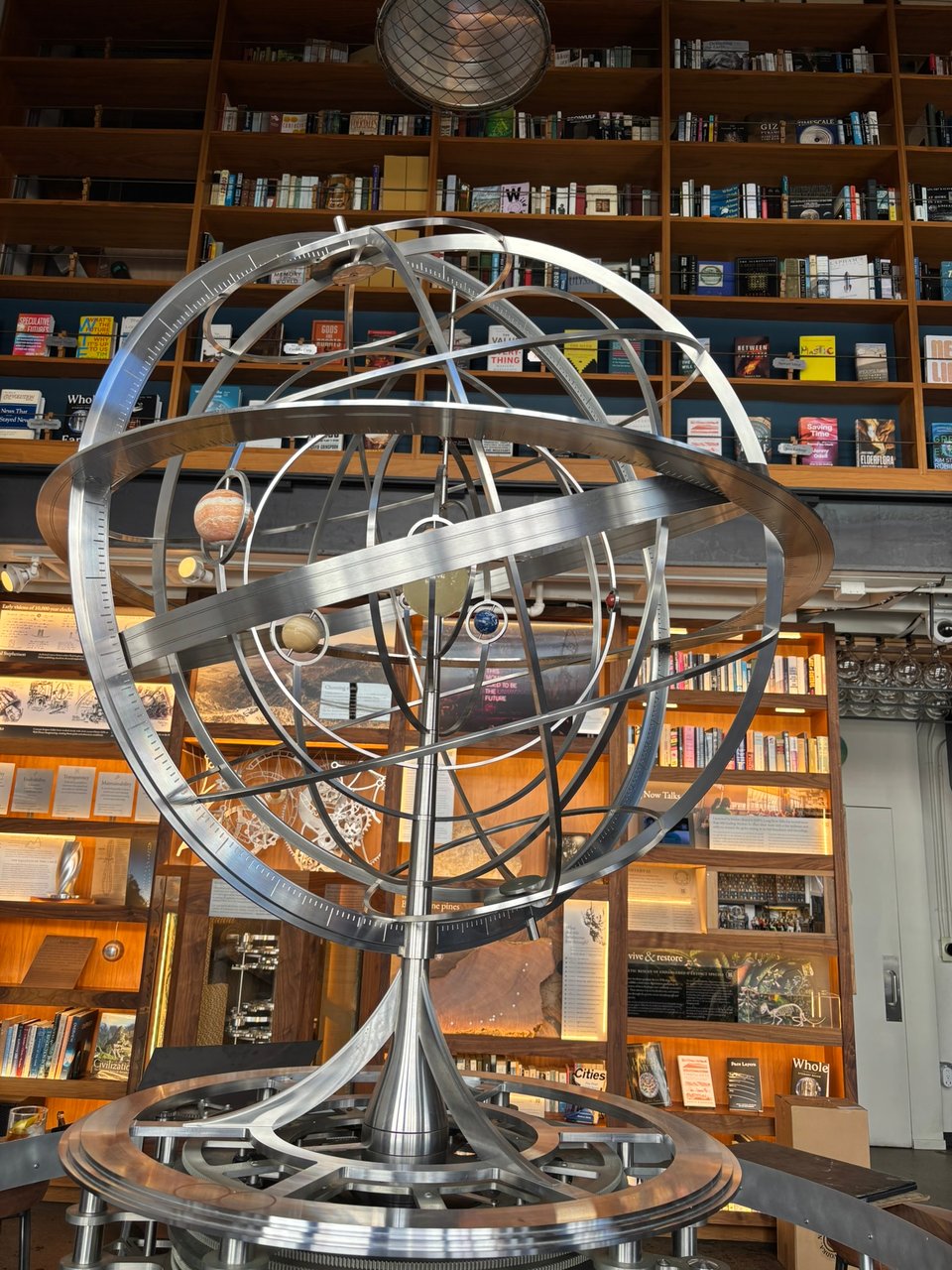
I was intentional about visiting while in San Francisco, as a kind of ambient pilgrimage. Brian Eno, one of my favorite experimental musicians and producers, co-founded the Long Now Foundation and its hq beautifully reflects his signature touch, transforming a physical space into a living, breathing soundscape of long-term thought.
Eno helped develop the chimes for the expansive Long Now Foundation’s 10,000 Year Clock project. It’s an entirely mechanical clock built to keep time for ten thousand years, wound automatically by the daily heat of the sun. In the corner of The Interval, I saw plans for the Clock on display. The real Clock, paid for largely by Jeff Bezos’ $42M, is still being assembled inside a mountain in West Texas. The Clock has ten bells, but they don’t ring on a schedule like a church bell. They only ring when someone is there in person. A visitor who makes the trip into the mountain has to wind the Clock to hear them. Bells rang for the first time in 2022, a year that keeps coming up in this story.
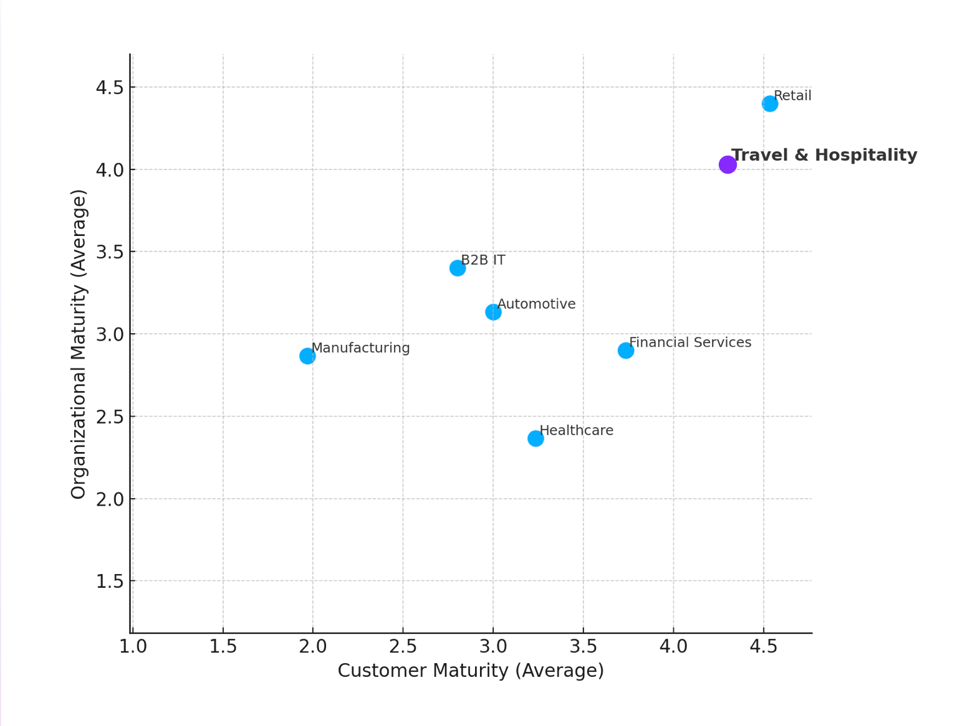
I vividly remember sipping coffee at The Interval, while analyzing survey data and building charts like the one above for an upcoming conference presentation. I’d recently surveyed a room of Sitecore MVPs at the 2024 MVP Summit in Nashville, asking them to rate industries on two dimensions: how ready organizations are to adopt emerging technology, and how much their customers expect connected digital experiences.
Retail and travel and hospitality landed in the top right corner. Companies in those verticals move fast, and their customers already expect to book, buy, and get help on digital channels. Healthcare and financial services told a different story since their customers are fairly digital, but heavy data regulation can slow the organizations down.
The long horizon of the Clock made me decisive, and I left with a renewed focus on travel and hospitality, the industry where my background in experience strategy could make the biggest difference.
There’s another monument I’ve stood in front of built as a message to the future. In 2010 I drove out to the Georgia Guidestones, a 20-foot granite monument commissioned by the pseudonymous R.C. Christian and inscribed in eight languages with instructions for post-apocalyptic civilization. The mysterious stones stood until their destruction in 2022.
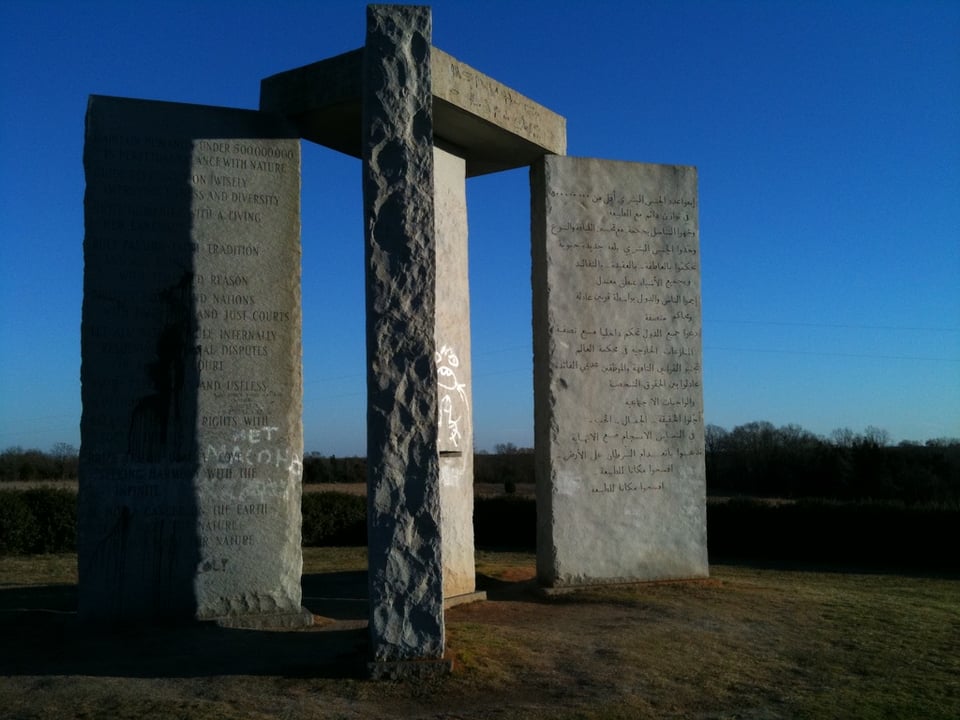
I the same sort of feeling there as I did at The Interval, a mix of awe and alarm at the premise of the projects, a presumption that you could leave notes for people who don’t exist yet.
In 2022 someone bombed the Georgia Guidestones off their hill, and the state demolished them entirely by the afternoon. These are both monuments to the future. One gets a cafe and museum in San Francisco, and the other was destroyed by dynamite in the South. I guess when you’re trying to speak to future generations, you don’t always anticipate how they’ll receive it. That’s the risk of thinking in generations. You create things for people you’ll never meet, and then they get to decide what it all means.
And yes, 2022 again. That year I wrote a small book, a collection of essays on documentaries for new and expecting parents, written to my son when he was first born. It’s my own monument, a note to the next generation in my family. Those essays are a little time capsule, preserving the version of me who wrote them.
Now for some news: I’m finally publishing the book in print. The final layout is nearly done, and I’m aiming to launch before the holidays. You’ll hear about it here first.
Which brings me to the new East of Eden on Netflix, a seven-episode miniseries based on John Steinbeck’s 1952 novel. The book follows two families in California’s Salinas Valley stretching across generations from the Civil War to World War I. I read the novel as a teenager, and it became one of my favorite books. Decades later the book remains a classic, and I’m the one who changed. I see storylines and plot points in an entirely new light this time around. The quiet trick of monuments is they stand still while you measure yourself against them.
This was originally posted as the Feature in Thinking in Generations · The Catalog · №009, an issue of my weekly newsletter The Catalog. You can Subscribe for weekly insights.