

This summer, Atlanta will host 8 FIFA World Cup matches at Mercedes-Benz Stadium, including a semifinal on July 15. Spain, Morocco, South Africa, and others will play in front of 75,000 fans per match across 5 weeks of group stage and knockout play. Atlanta is about to experience the largest sustained tourism event since the Olympics. I remember living in metro Atlanta during the 1996 Summer Olympics, and I’m very interested influx of travelers for World Cup this summer.
For hotels in metro Atlanta, the math is straightforward. Demand will surge. Hotel rates will spike around the matches. Room booking occupancy for major hotels in the area will probably be 90%+. You can already see the pricing strategies in play. That part is easy, but the harder question is what happens after the last match ends.
The Demand Hangover
Major events can create a sharp, concentrated spikes in hotel demand. Then they leave a hangover.
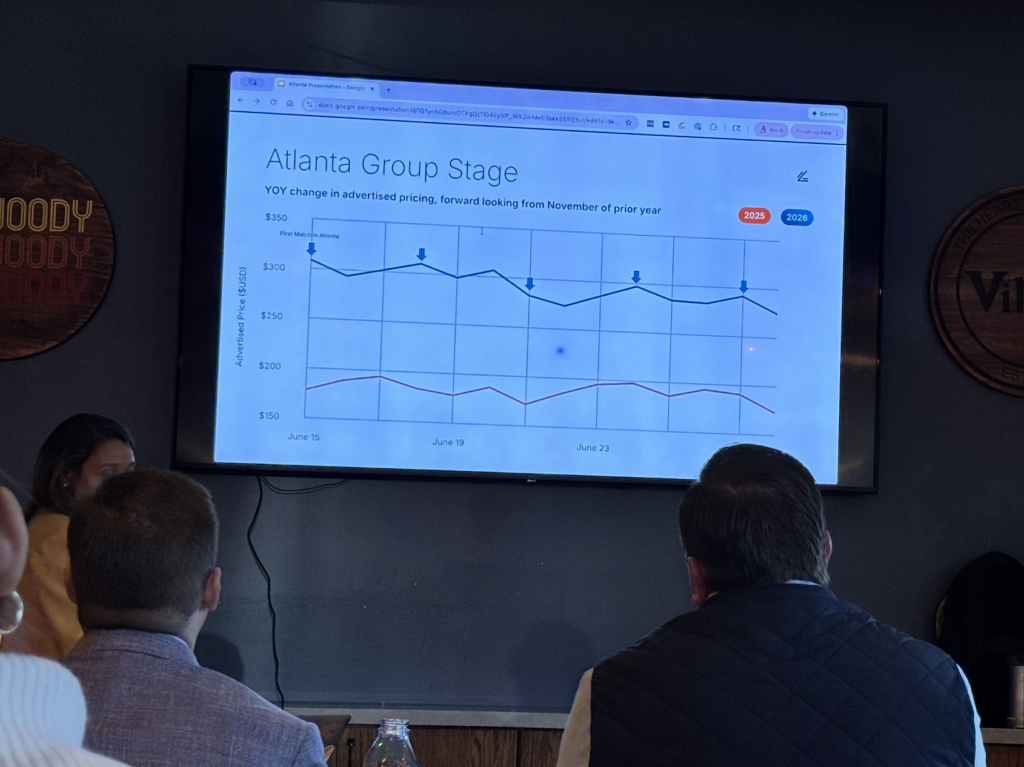
I recently attended an Amadeus presentation anticipating the World Cup matches. In the chart above, blue arrows point to the match days and corresponding hotel rate spikes in pricing.
Once major events end, occupancy often falls below pre-event baselines for a couple months as the market recalibrates. The post-event trough is well-documented across World Cups, Olympics, and large-scale concert tours. Hotels that operated at 90%+ occupancy during the event can find themselves struggling to fill rooms in August and September, when the influx of international visitors disappears and local travel patterns have been disrupted by months of event-related congestion.
This pattern creates a strategic fork for every hotel operator in a host city.
Path 1: Treat the event as a one-time revenue moment. Maximize rate. Fill rooms. Count the cash. Watch the demand disappear when the tournament moves on.
Path 2: Treat the event as a once-in-a-generation opportunity to build lasting guest relationships. Capture preferences. Collect first-party data. Establish the foundation for re-engagement that extends well beyond July.
The difference between these two paths is marketing technology. Specifically, it is the ability to identify, understand, and re-engage first-time guests at scale.
The First-Time Guest Problem
Consider the scale of what is about to happen. Tens of thousands of international visitors will check into Atlanta hotels for the first time. Many will have no prior relationship with the property or the brand. They are there for Spain vs. Saudi Arabia, or for the semifinal, or for the atmosphere. They are not thinking about loyalty programs or future booking intent.
For hotels without a digital experience platform and customer data infrastructure in place, these guests are ghosts. They check in, they check out, they leave a transaction in the PMS. There is no preference capture. No behavioral signal. No mechanism to reach them sixty days later when they are planning their next trip and might actually consider returning to a city they just discovered.
For hotels with the right tech stack, the same guests are the beginning of a relationship. Their booking channel, room preferences, on-property behavior, dining patterns, and digital interactions become data points in a guest profile. That profile feeds personalized post-stay communications, targeted offers, and re-engagement across digital channels that’s calibrated to the guest segment.
The gap between these 2 outcomes is the gap between a CRM entry and a living guest profile in your DXP.
Collecting Guest Data During a Demand Spike
During an event like the World Cup, the volume of new guest data entering your systems increases by an order of magnitude. The question is whether your infrastructure can absorb, organize, and activate that data before the guests leave town.
Real-time guest identification. Connecting anonymous website visitors to known guest profiles as they move from browsing to booking to on-property engagement. This is where a CDP earns its keep. It stitches together fragmented signals into a unified guest record, giving your team a complete picture rather than a series of disconnected transactions.
Preference capture at every touchpoint. The check-in kiosk, the room service order, the spa booking, the mobile app interaction. Each one is a data point. Hotels that can collect and unify these signals during a high-volume event are building a first-party data asset that compounds long after the event ends.
Personalized post-stay engagement. This is where the real revenue lives. A World Cup guest who had a great experience at your property is a warm lead for future Atlanta travel, loyalty program enrollment, or cross-property booking within a brand portfolio. The window to reach them is narrow. Personalized post-stay emails, segmented by guest profile and behavior, should deploy within days of checkout. Generic “thanks for staying with us” messages do not cut it.
Content personalization on the website. When a past guest returns to your site six months later, marketers can activate that data with personalized content that reflects their previous stay. Returning visitor experiences, localized offers, and segment-specific messaging turn a website into a relationship tool rather than a brochure.
The Compounding Value of Event-Driven Data
The World Cup is an incredible opportunity to gather rich, first-party customer data. Hotels that strategically capture and activate guest data during the tournament are building an asset that generates value for years.
Think of it this way. A hotel that captures 10,000 new guest profiles during the World Cup, with rich preference and behavioral data attached, has just created a targeted marketing audience that did not exist before June 15. If even 5% of those guests can be re-engaged for a future stay, the long-tail revenue from the event dwarfs the rate premium earned during the tournament itself.
Atlanta as a Test Case
Atlanta is uniquely positioned for this. The city already has a deep events calendar, from college football to conventions to concert tours at State Farm Arena. Hotels here are familiar with demand spikes. The World Cup is different only in scale and international reach.
For hotel operators evaluating their digital experience maturity, the question is simple. When 75,000 fans walk into Mercedes-Benz Stadium on June 15 for Spain vs. Cabo Verde, and a percentage of them are sleeping in your beds that night, will your marketing technology systems let you remember them? If the answer is no, you are probably leaving more than room revenue on the table.
Leave a Reply